
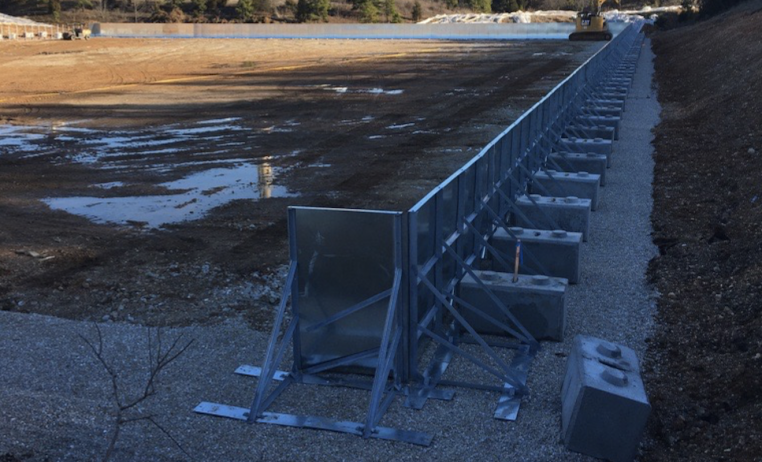
One of the key advantages of a modular tank system is that extensive foundation work is often unnecessary. Unlike many conventional welded tanks, ModuTank systems can typically be installed on a properly prepared earthen surface without requiring a full concrete foundation.
Start With a Stable, Level Surface
In many applications, ModuTank systems can be installed directly over native soil. The subgrade should be stable, reasonably flat and level, and capable of supporting the weight of the tank and its contents.
For compacted earth tank pads, soil compacted to approximately 90 percent Proctor, or equivalent, is generally considered adequate.
The installation area should also be free of large stones, brush, debris, and other objects that could damage the tank liner. If the existing surface contains large or uneven stones or poorly crushed gravel, a layer of sand can be used to fill voids and create a smoother, more uniform surface beneath the geotextile underlay and liner.
Plan for Drainage
Proper drainage around the tank is another important consideration. The site should be graded so that water flows away from the tank rather than pooling against the wall panels during heavy rainfall.
Adequate perimeter clearance should also be maintained for installation, access, and other project requirements.
Is a Concrete Foundation Required?
A full concrete pad is almost never required for ModuTank systems. However, tanks can be installed on existing concrete surfaces or purpose-built foundations when desired.
For round tanks, one option is a concrete ring wall supporting the tank perimeter while compacted earth remains in the center. Similar perimeter foundation designs can be used for rectangular tanks, to keep construction costs at a minimum.
Free-Standing Tank Installations
Modular tanks can also be installed in a free-standing configuration without being mechanically anchored to the ground. In these applications, appropriate ballast is placed on the tank footing plates to resist applicable wind and seismic forces.
Every Site Is Different
Soil conditions, tank dimensions, capacity, wind and seismic requirements, drainage, and local regulations can all influence site preparation.
One of the benefits of modular tank construction is its ability to accommodate a variety of site conditions. With proper planning and a stable supporting surface, a modular tank can often be installed with considerably less foundation work than many traditional storage tank systems.